/pleasedontbanme
Also, an Instagram /account/ was reinstated, not all of Instagram.
These are popular consumer brands, and colloquialism would prefer their "insta" or "instagram", rather than "instagram profile".
Level 1 - Start a thread on Hackernews or Twitter.
Level 2 - Fuck'em.
EDIT - Downvoted? Do others accept this is true? Why?
Under the hood, our human propensity toward "storytelling" and social cohesion is both a blessing and our bane. People collectively go for convenient (but leaky) abstractions, leaders, influencers, fads.
AKA the market can stay irrational longer than you can stay solvent.
The cesspool is not specifically American. As long as the music plays, economy's touted "fundamentals" pretty much come down to ape psychology. The music just plays louder is some places than others, at the moment.
This is not a legal issue. Its not a freedom of speech issue, which in any case can also bypassed by corporate policy.
Imo long-term, companies should be legislated into having fair ban appeals, and enforced in transparency of why accounts are banned after they are a certain size.
Then I would happily start debating the removal of these employee specialty services which allow this. I say this as someone who has used this power before for legitimate reasons.
There should be official channels to do this with companies as large as Google, Facebook, Twitter, Twitch, YouTube etc.
Freedom of speech can be ignored - if the community guidelines say so. Similarly, if the guidelines are that if you 'offer up' you can be reinstated, and you are fine to do that, that's fine too?
We're in the world of corporate policy now. Laws have nothing to do with! These are private corporations, and their policies determine what's right or wrong on their platforms.
Ugly female? Worth a shot.
But seriously, I wrote a post about my youtube account getting banned and without telling me what caused it just shut down my request for review. Sounds like in all of these companies you can either have a false positive AI flag you, someone decide they dont like you online and report you for something that isnt necessarily true/the case, and then you have some tech workers who either dont care enough to really fix problems or enjoying their fiefdoms and the power they wield at strangers.
Blocking your Facebook account can lead to losing access to support groups and local marketplaces that may be important to people in need, and it is absolutely disgusting that they are allowed to kick people out for no reason.
Don't you have that backwards?
I might not like it, but they are in their right. I can always create my own web property.
By that unjust actions they actually show the value in de-centralizing WWW back to good old days.
Given what I’ve seen on dating apps, you’re prime material.
Typically with a store, if you're causing harm, the community can petition for you to lose your license. And all that comes with legal protections for due process.
On youtube or instagram, your entire business which you invested time/money/body into, is entirely hanging by the thread of some employee having a decent day or finding you attractive.
There's a near-infinite pool of people willing to sink absurd amounts of time and money and other resources into these social networks.
Pretty much everywhere is aware of the risks.
It seems to be a risk many are more than willing to take.
Edit: It's fixed now.
This behaviour on the part of Meta completely ruined what was quite a nice little community and I've not been able to get a satisfying explantion for this inconsistency. 'We realised the decision that got your page unpublished was wrong and reversed it, but we're still keeping your page unpublished' seems massively contradictory to me.
The admins of the page (myself included) have developed our own app pretty much out of spite to replace the Facebook page so it's not the end of the world, but I'd love to know what's going on behind the scenes that such a state is even possible for a page. It feels like there's something pretty fundamentally wrong with how Facebook handles page moderation.
I got a taste of this when I (unsuccessfully) tried to fix a grossly inaccurate situation with Facebook places (the places for two very different schools were merged, and any attempt to create a new place to fix it would quickly get incorrectly auto-merged).
I discovered a large Facebook-endorsed community of people working for free to try to fix Facebook's places data without any special tools or support (might have been this https://www.facebook.com/editorcommunity/). People would just bang their heads constantly against Facebook's systems, and get nowhere, even though there were Facebook employees managing the group. I joined for a time, never got my issues resolved, and eventually just had to quit because it was too frustrating. It was just offensive how much effort those people where volunteering and how little help Facebook would give them to be successful at helping Facebook.
That seems like a situation ripe for abuse. Just continually report any account you want taken down.
Depending on your check mark, subscriber count, and audience, you can easily sell any blue checkmark for 1-10k.
Access to the Twitter dashboard? 50k
0day account takeover - 150+k, rarely happens anymore
It sounds like she's saying she met up with more Meta employees than she actually fucked. So what happened with the others, did they get cold feet and back out of the deal? Maybe. Or maybe they they didn't realize there was a deal at all, and thought the meeting was simply a date that didn't pan out.
How do we know that the conversation was "i will have sex with you if you unban my account" (which is pretty clear quid pro quo), and not her establishing a relationship then asking for a favor from a "friend"? It seems like a pretty dark rabbit hole if Meta of all places has to figure out if this person has a relationship with a person for pragmatic reasons or not. How many relationships do you have in your life that exist to facilitate X/Y/Z.
People trying to befriend people who are perceived to have some kind of power (be it economic, social, political, or in this case i guess technological?) is a very old tale.
Friendship won't be treated like a bribe but sex definitely could be, especially if one party says it is.
No wonder there is no easy way to reach support at Meta.
[0] https://usdailyreport.com/2020/12/10/christine-fang-eric-swa...
[1] https://nypost.com/2020/12/08/suspected-chinese-spy-slept-wi...
Jokes aside. Maybe the story is true, maybe it's just fabricated to tell interesting stories.
In an ideal world, there would be transparent governed by law policies what can and can not be shown or done. But facebook, instagram, google, tiktok ... will fight to their graves against transparency. It's bringing them money.
Like the facebook/google ad deal, facebook maga money, googles ad dominance ...
It is easier to stonewall.
Like others have said, however, there could be some other mechanism, whether paid for or something for scenarios like this where her account was worth a lot to her and the money could even be refunded if they agree that the red flag was bogus.
The other hard problem is that even the fact she works in the adult industry is enough for some people to flag the account. Lots of parents don't like their kids following insta stars who might lead them astray!
Human sexuality is one of the only realms where (to some) ignorance == virtue. At some point these kids are going to have to live in a world that includes sex workers, thirst trap Instagram accounts, and a range of human sexual behaviours. Can't keep them ignorant forever.
Anyway, this incident shows how ridiculous the Big Tech is with providing no support and no means to dispute their wrongdoing - people are forced to do crazy things like these just to get their accounts back!
“[hard drug]-addict had sex with man to get more [hard drug].”
Here I guess it’s a bit different cuz she’s an adult content creator … but the idea is more or less the same. What would the Kardashian’s do if they got cut off from Instagram?
The analogue here is the casting couch, sans the implication that it's sprung unexpectedly on her.
Are you sure there is a clear-cut line between the two? Which was she first, a sex worker or a habitual social media user? If she was first a social media addict, then it seems conceivable that she found this line of work because it was adjacent to social media, a straight forward way to turn her social media addiction into a job.
This is like giving the right people free promotional <whatever it is you make> because your booth got kicked out of the craft fair for a dumb reason.
game changer.
All she had to do was say nothing, and Meta probably wouldn’t have found out. But it’s going to be very simple to look at the admin tool logs and see exactly who unbanned her account.
We both know that the chances of an internet entertainment professional doing that are close to zero.
I’m also blown away at how short-sighted this woman is about the man’s employment, after he did her frankly a big favor in return for sex. Not to mention her account will just get banned again, given she admitted to it on video.
Two possible ways this might have gone down:
Employee is cold-contacted with an upfront offer: "Let's meet up, I'll have sex with you, and exchange you can help me get my account unbanned"
..or..
Employee is cold-contacted with something like: "You seem like a cool guy, let's meet up" Then a few days later they get hit with "Btw now that we've hit it off, can you help get me unbanned?"
It's perfectly OK to hate Facebook as a platform or a concept, but their ad revenue team is very good their jobs, and I would be very hesitant to question their decision-making on what does and doesn't attract advertisers.
We should not be letting "our systems" in Big Tech do their thing. Specially when it comes to a person's accounts
BTW: For example in Switzerland it is legal, you even have (in theory) to pay taxes. But still the problems are the same (human trafficking etc), nothing changed, and if you go to the police you have accidents like floating dead in a river a week later. Legalize it but make nothing to take the mafia away from it brings nothing, in fact it gives them a legal way to make money.
Maybe it should be a state owned business only and not a private thing, sounds crazy but if you work for the state not even the mafia would dare to touch you, you have stable employment, insurance and medical services.
I agree with the other comment about how we need legislation to ensure proper channels on how to get account access back or services. Far too often if you dare question say Google or Facebook your account may be banned for life with little retribution on your end.
That's why these platforms need to be broken up or follow standards that could allow people to take their social graphs/data and go to other competitors.
Not sure you're assigning the responsibility to look after someone's career to the right person here.
Hopefully she isn't an idiot and has downloaded everything she cared about from facebook.
But the fact is that we're all talking about this, inside tech spheres as well as outside. A literal real-life "who do I have to screw to get my stuff back?" moment.
It means that no matter how little you respect what she has done, she may have just changed the world. Or, we'll forget in five minutes and Metabook will continue to ban people with impunity.
Just my opinion, but someone being willing to lose something they sold their body to win back is reasonably respectable. Certainly they've done the world a big favour, whatever their motivations.
Banning her at this point would look pretty vindictive: "You revealed corruption in our organization, so we're banning you." Would make for some pretty bad headlines. They might still do it, but it's not a good PR move.
> I’m also blown away at how short-sighted this woman is about the man’s employment, after he did her frankly a big favor in return for sex.
It's not a favor if you had to pay for it.
In the US, at least, “plain discrimination” by private parties is generally legal, but for regulated utilities (which Facebook is not) and fairly narrow sets of specifically prohibited bases of discrimination by public accommodations.
If you want a general rule applying something like the rational basis test used as the minimum standard applicable to public discrimination to private commercial discrimination, that's a fairly radical change to the law.
You shouldn't argue that a farmer who was kicked out from Facebook for absolutely no reason should no longer have the right to access a wider variety of local offers for farm equipment on Facebook Marketplace, or have a better chance to sell their produce.
And you shouldn't argue that people are destined for this fate for the rest of their lives because of a primitive algorithm put in place by people who have no morals.
They are not in their right. They are abusing their position, and they are harming people.
It’s a risk they take because there’s no other choice.
Consider, for example, flights to a corrupt country. To get through customs unscathed, every passenger is required to bribe the staff at the airport.
Just because the passenger pulls out their wallet and hands over a bribe at the first sign of friction, does that make the passenger more guilty than those who set up this corrupt system? Those that benefit from the corruption?
It must always be those with power that we hold to account. That's not to say that those who participate in the system should have zero consequences (which, in these examples, is not the case - they've paid something, whether with their wallet or with their flesh) - but until those in power are fully held to account and the systems are changed, you are blaming the victim, even if they did initiate this form of corruption.
If they set up the corrupt system and everyone is expected to pay bribes, then the newly incoming passenger is not really the initiator, in that case the corruption is systemic, and i would put most blame on management to not make steps to eliminate it, but i agree that in this setup the bribees are more responsible than bribers, as they have more experience and information about the corruption in the system.
But let consider a slightly different case - a bureau (say building authority), with many twisted bureaucratic rules and procedures, where any request takes long to proceed and is often denied, but generally not corrupt. People just patiently do the necessary steps and accept it, or shrug off and go away. Then someone does not accept that and instead offers a bribe to get pass their request fast. In such case the initiator is clearly responsible for corruption, while the bureau is just responsible for general bureaucratic inefficiency.
And lets consider third case - driving license exam, and someone who fails it just bribes driving inspector to instead make it pass. In that case it is not even inefficiency, the license should be rejected and the briber just seeks unfair advantage. That is even more clear that initiator is more guilty, although the driving inspector has the power.
So, i would say that there are two kinds of corruptions - first, where briber wants something that should get without bribes, and second, where briber wants some unfair advantage.
Your premise is that acting on the desire of an unfair advantage is the greater immoral act, and the act of accepting the payment for an unfair advantage is less morally bankrupt.
In each of these scenarios, the person being bribed has the power. They have nothing to lose if they reject the bribe.
Yet, if they have nothing to lose when _accepting_ the bribe, that is how corrupt regimes start.
Of course, one could argue that it depends on the corruption. In your case of a building authority, imagine one that always says no regardless of the request. Maybe they let through the odd high-profile project where someone in the project is chummy with the director of the authority. Arguably, this building authority is already corrupt, and merely hiding behind the excuse of bureaucracy. (We don't tend to think about social capital as a form of bribery, but it very much is)
In the case of the driving inspector, they are potentially licensing an individual who will get others killed. Morally speaking, any future deaths are at least partially attributable to the driving inspector.
I suspect part of your position hinges on a malicious intent in the initiator. However, power and responsibility are not separable - and cases where there are possible consequences, morality must be judged in part on the basis of that responsibility.
As I say, we're getting into the weeds - these hypothetical situations are in many ways divorced from the original question, so let's look at that:
- A person is kicked off an online communications platform. Nobody is quite sure why, but there are some pretty likely conclusions.
- The platform is known for bending the rules for high-profile accounts
- The person can prove that they are not breaking any consistently-applied rules (assuming valid interpretation of vague rules should be judged on whether their peers are allowed to post similar - and in this case, she pointed out that her content is well within moral norms for the platform)
- The platform offers no accessible recourse (except for those with social capital) and not just bureaucracy, but hidden bureaucracy dependant on the whims of a hidden adjudicator who has nothing to lose for interpreting the rules harshly.
- Very limited harms if accepted, potential loss of revenue, personal content, position in a (digital) society, freedom of expression etc if rejected.
In this case, I'd say the briber has, at the point their account was terminated, already lost a lot to the corruption of the platform, and yet the bribe was still over-paid. Saying that theirs was the more immoral act seems intensely unfair, when they did the only thing they felt they could to re-gain justice.
https://www.ncsl.org/research/civil-and-criminal-justice/dru...
No you don't, you just need to make buying sex and pimping illegal, you can do that without punishing the victims, what you call "sex workers" is a euphemism for sex trafficked women.
How involved are you in combatting sex trafficking? I've been involved in this to varying degrees for a few years now, and this is would be new information to me.
Sex trafficking and sex work is a Venn diagram with overlap, certainly, but they are definitely not the same. Many women do sex work as an independent decision, choosing it over other choices that they are presented with, and they find fulfillment in it.
Trafficked people are, at best, highly vulnerable individuals who feel they don't have any alternatives and are brainwashed by people close to them. More often than that, they are simply abducted and traded as property. Sex trafficking is a recognized form of slavery. Very different from independent sex workers.
EDIT:
The reason it's important to get this distinction right is because misinformation around it dilutes the seriousness of actual human trafficking. There are people in slavery who need intervention from police and governments. Not middle-class women in Orange County who do private sessions in the basement of the home they own.
But if you want to actually address the problem, you do need to decriminalize prostitution.
> Your request has been blocked.
> If you have questions, please contact us.
They are so huge they should probably be classified as a public utility of sorts. This is a tough pill to swallow for this site since it could possibly derail the tech gravy train.
This is a problem with most of mega tech right now. Nobody can spin up a fair competitor to Youtube because Google can throw money from other parts of the business to keep it dominant. How are you supposed to compete fairly with Amazon when they can reinforce with AWS money?
Nor are the differences as clear as you make them out to be. Sure, there are clear cut cases of human trafficking, but how do you know that your Orange County basement whore isn’t caught up in an abusive relationship with some indolent man who uses her as his livelihood? More to the point, how does the john know? The whole narrative that women freely choose sex work and find it fulfilling may be true in some cases, but there’s no easy way to tell which cases those are, and the human consequences of guessing wrong are awful.
https://www.nytimes.com/roomfordebate/2012/04/19/is-legalize...
The best estimate I've seen for percentage of active sex workers that are currently being trafficked was between 3 and 4 %.
https://aella.substack.com/p/what-percentage-of-sex-workers-...
There's no such thing as a “de facto utility“.
If you mean “Facebook is the kind of thing that the government should regulate as a utility”, well, that's fine, but that's something that requires at least regulatory, if not legislative, action to make happen and set the regulatory rules (including any applicable anti-discrimination rules) for.
So, again, the applicable rules need to be created elsewhere in government before Facebook is taken to court for allegedly violating them.
Where did I say they are to be taken to court?
Electricity, water, natural gas, internet, and district heating are utilities. Facebook isn’t. There are no transmission lines or pipes running to each Facebook user directly from Facebook, there’s no physical reason that other social networks can’t exist.
It’s not a utility just because several billion people use it.
Yeah but you can also make the same argument for education: education is not a utility because several billion people like to be educated.
Facebook connects people and businesses, groups. It’s basically the same as if someone decided to ban you from using SMS or snail mail or libraries at this point.
> no transmission lines
> no physical reason that other [social networks] can’t exist
Sorry for nitpicking, but you can get internet without transmission lines too (just as phone service) - and it's still an utility :V
But I am just nitpicking, sorry :V
No, they are expressly for what would be, under the law without Section 230, publishers.
The entire purpose of Section 230 is to allow platforms (and users!) to freely moderate content on based on their own views of what is appropriate without incurring liability as a publisher as would otherwise accrue to those exercise such control of distribution.
(Section 230 protections wouldn't be needed for common carriers, who would, as such, be forbidden from exercising the kind of editorial control which would, without a safe harbor, produce the kind of liability from which Section 230 provides a safe harbor.)
That being said I log into Facebook once every 6 months approximately. It was replaced by WhatsApp and Instagram for me, however my point still stands as much for those platforms as it is for Facebook.
All adult women want is the empowerment to make decisions for their own bodies. It is theirs, after all.
No, it's completely intertwined. Because these pressures exist in numerous contexts, we've developed both social norms and laws to limit the race to the bottom, overwhelmingly with the support of the women affected by those pressures.
> All adult women want is the empowerment to make decisions for their own bodies. It is theirs, after all.
Which women? More women identify as "conservative" than "liberal"--and even among the latter, legalizing sex work is not a majority (and possibly not even mainstream) position.
My mom thinks sex work is very bad for society. It's probably one of the things my mom, all my aunts, and my wife's mom and aunts agree with, despite being from different countries and otherwise having quite different political views. Opposition to sex work is something that women tend to get the most riled up about, because ultimately its mothers and daughters that suffer from the consequences of sex work.
Not even close to reality. More women identify as liberal than as conservative, more are registered Democrats than Republicans, and even within the Republican party women skew moderate rather than conservative. Among nonvoters the gender breakdown on various issues that can be easily identified as liberal or conservative shows that women favor policies that are generally considered liberal.
Similarily theres men who do the same thing using either their looks or wealth as a chip.
We are human, but we are also bunch of monkeys in the end.
Which is why prostitution is embraced in the Muslim world, Asia, etc? Or maybe these completely different groups of people tend to overwhelmingly agree on taboos against sex work because it reflects something fundamental about human psychology?
As for the "Muslim world", I wouldn't be so sure that there's anything behind the sexual taboos held except garden variety discrimination. Monogamy is a sacred duty for women, but men are allowed to take up to 4 wives by Islamic law. Why can't women have 4 husbands?
Read Quran, Verse IV: 3. The best part is that if you can't be nice to your wives, just marry 4 slaves instead! That's a pretty serious endorsement that the roots of "taboos against sex work" are really just part and parcel of how men in ancient times maintained control over women.
Men get 4 wives, women get but one husband. Not only is it unfair, it's purely about keeping control over women. Or 4 women, for that matter.
Are these purely Christian morality or do they hint at very real underlying biological reasons total sexual freedom might be problematic to a society? These sorts of things do happen.
Your hypotheticals talk about people who are dishonest. The problem is inappropriate activity outside of a monogamous relationship. If one partner doesn't discuss their behavior with their other partner, the problem wasn't the sex worker, it is that they are not being honest about their activities. Your examples are moot anyway because regulated sex workers are tested every day, and are required to use condoms to protect against HIV. The risk of STD or pregnancy with a regulated sex worker are miniscule. It's far more risky for the husband to go to a bar and pick up someone randomly.
> Are these purely Christian morality
> total sexual freedom might be problematic to a society
At least for now, we have sexual freedom in many jurisdictions all over the world, and society seems to be chugging along. Sexual activity isn't bringing the world to it's knees. (hee hee) The concept might be problematic to your vision of what society should look like, but the rest of us are enjoying life and letting others live their life choices.
Sometimes societal evolution takes a wrong turn and embraces ideas that are maladaptive. For example, in the Netherlands, the Muslim immigrants who are demographically ascendant for the most part embrace these “1950s” ideas, and are outcompeting the Dutch folks who have embraced sexual liberalism.
The Netherlands has chosen to legalize prostitution, for good reasons which have proven in practice that the argument that you are making is invalid. That immigrants (the bulk of which joined since that legalization) are demographically ascendant and embrace those same ideas that you espouse is utterly irrelevant. The point is: there is ample evidence that the theory you push is wrong.
It isn’t “mainstreamed” (see original comment in this thread) anywhere. Even in countries where it’s technically legal—like Bangladesh, where I’m from—the associated business activity is still illegal, and there are strong social taboos against sex work.
Women tend to be less libertarian than men, and sometimes that breaks towards more liberal attitudes (they are more likely to favor generous social programs), and sometimes that breaks towards more conservative attitudes (they are more likely to oppose legalized prostitution and pornography).
As of 2016, attitudes were closely divided on legalizing sex work overall (40% in favor, 43% against). But the gender breakdown was striking: https://www.vox.com/2016/3/11/11203740/prostitution-legal-me.... Men supported legalization 51-36, while women opposed it 30-50.
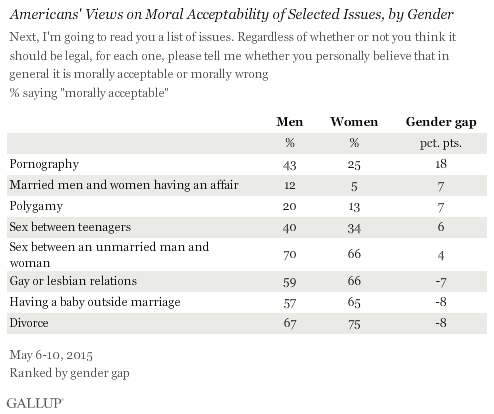
Women similarly oppose pornography--just 25% find it morally acceptable, compared to 43% of men: https://content.gallup.com/origin/gallupinc/GallupSpaces/Pro...
Being a Democrat, of course, isn't dispositive of anything. My mom is a democrat, because she likes Obamacare and Anthony Fauci. But she's as socially conservative as any republican. (Like Black people: https://news.gallup.com/poll/112807/blacks-conservative-repu...)
Social libertarianism is championed mainly by the white college educated wing of the Democratic Party. But the party is ideologically diverse. For example, under 60% of Democrats say that “changing gender roles” has “made it easier for women to lead satisfying lives”: https://www.pewresearch.org/social-trends/2017/10/18/wide-pa.... For Democrats without a college degree, it's under 50%.
Sorry for the lengthy rant, but people projecting their views onto "women" (or another popular one these days, "people of color") has become a pet peeve of mine. When you say stuff like what "adult women want is the empowerment to make decisions for their own bodies" you’re making a libertarian argument, and statistically that’s going to be most appealing to white men. (That doesn’t make it wrong, but if you’re going to bring identity into it you don’t get to play fast and loose with what arguments different groups tend to find more compelling.)
> Who cares? There's no law against this.
There are, in fact laws against extramarital (and, for that matter, premarital) sex, though in the US those that remain in the books are unenforceable (though the line of Constitutional law making it so is under massive assault at the moment, so maybe not for long.)
Ok, so now we're in 1890 or so. Really, this is beyond absurd.
> The literal commoditization of it through legalized prostitution is a merely a specific manifestation of a more general cultural attitude.
No, it means that you recognize that realistically prostitution is going to happen anyway, regardless of what you think or feel about it, so you try to make it as safe for the sex workers as you can and legalization is a very important step in that.
I give up.