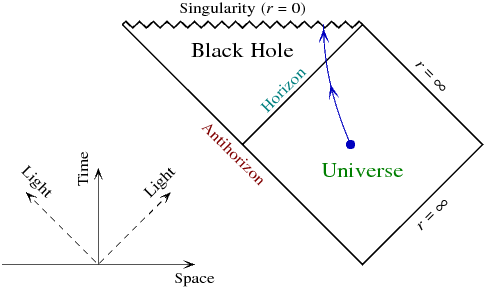
Talking about the inside of a black hole is indeed rather pop-misunderstood though, yes. But it's not like physicists are especially confident about the details either. Theoretical astrophysics changes a lot as time goes on and our instruments improve, and it's a rather hard field to do experiments on to get better data quicker.
⸻
1. I must admit to a lack of sufficient GR education to feel confident in this, but I think that one of the issues that made physicists unwilling to accept the idea of black holes when they were first postulated was that there ended up being a division by zero in the mathematics.
They don't just have the same name, they are the same thing.
A Schwarzschild black hole has both: a removable singularity at the event horizon that is just an artefact of a particular choice of coordinates and a true non-removable mathematical singularity at r=0 where curvature really does go to infinity. It also wouldn't be much of an issue in classical physics, because this singularity is always hidden from outside observers, so the mathematical weirdness there can't screw with your normal predictions in space outside the black hole. The problems start once you consider quantum mechanics, because any such singularity will break unitarity (a fancy way of saying that probabilities must add up to 1), which means your theory as a whole can no longer make predictions. This has opened a whole can of worms with a bunch of solution attempts, which are all sadly untestable for the foreseeable future.
Well, the Ricci curvature scalar blows up to infinity, which is obviously unphysical.
You say that and yet this thread is full of people arguing about it, and there's an entire Wikipedia article on this: https://en.wikipedia.org/wiki/Gravitational_singularity.
In fact, that article says:
> No complete and precise definition of singularities exist in the theory of general relativity,
So which is it? It can't both be trivial to any grad student but also an open question. And things like naked singularities aren't proven to not exist either.
Also, general relativity is a classical, geometric-only theory. It seems obvious that better understanding what a black hole's singularity is would require quantum mechanics because the singularity is effectively what's "left over" of the physical material once you go beyond a neutron star.
What do you mean by not exist? If you postulate the right black hole with a naked singularity, it would have a naked singularity.
> It seems obvious that better understanding what a black hole's singularity is would require quantum mechanics
If you postulate a classical black hole, it won't require quantum mechanics to understand.
If Susskind's book does in fact say that, it's extremely disappointing to me, because, as a number of other GR textbooks will tell you (e.g., Misner, Thorne & Wheeler and Wald, the two great classic GR textbooks), the "switch places" is an artifact of a particular choice of coordinates (Schwarzschild coordinates), and does not represent anything physical. So it's not something that should be relied on. (Not to mention the confusion it causes when pop science sources repeat the statement and then draw all manner of wrong conclusions from it.)
The part about being "a surface in time" might be all right, assuming that by that he means "a surface representing a moment in time, not a place in space"--in more technical language, a spacelike surface. That is correct, and it's an invariant that does not depend on any choice of coordinates. But that invariant fact can be described without having to talk about the "switch places" thing at all.
I have trouble really conceptualizing black hole physics, I just think of it as a mass so great that nothing, including light, can escape its gravity. Works for me.
I'm sorry but this is blowing my mind. What???
Some of the things the paper points out are not emphasized in other sources, which is probably why the authors chose to write it. But there is nothing in the paper that is in the least questionable or ill-defined; it's all standard General Relativity as applied to the Schwarzschild and Kerr black hole solutions.
People like to reduce papers to a simple hot take, but the paper is more than that, offers viewpoints that are non-standard and speculation about new possibilities.
History of the Universe : What Is Hidden In The Core Of A Neutron Star? - https://youtu.be/YoYjkNQ27T8
That video goes into it... without getting mathy at any point.
One of the bits that you're having trouble with is the compression of matter to a point. There's a theoretical type of black hole known as a kugelblitz - https://en.wikipedia.org/wiki/Kugelblitz_(astrophysics)
A kugelblitz is a theoretical astrophysical object predicted by general relativity. It is a concentration of heat, light, or radiation so intense that its energy forms an event horizon and becomes self-trapped. In other words, if enough radiation is aimed into a region of space, the concentration of energy can warp spacetime so much that it creates a black hole. This would be a black hole the original mass–energy of which was in the form of radiant energy rather than matter
Of course I'm missing something here. I've taken QM and not GR so I would have this interpretation.
Common sense would tell you they can't exist at all because you can't compress atoms - you have lived your entire life with atoms being entirely incompressible for the practical purpose of anything you do.
Leaning on common sense to discuss fundamental physics has been wrong since round about the start of the practice of physics.
What do you mean by “particle” here? This kind of handwaving is fundamentally classical, and breaks down in the presence of quantum physics.
The easy thing to miss, and blew my mind when I read it. is that general relativity is the concept of space-time, emphasis on the time, and this is also compressed by the mass, so if this singularity can actually occur it would also take an infinite amount of time to fall into it. So nothing can actually enter it. From the point of view of an astronaut(deliberately ignoring all the other relativistic implications) flying directly toward the event horizon. As you approach you will quickly see the rest of the universe age and die. and if hawking radiation is real the black hole will evaporate in front of you before you can reach it.
What Happens at the Event Horizon? - https://youtu.be/mht-1c4wc0Q
Escape The Kugelblitz Challenge - https://youtu.be/v3hd3AI2CAA
Mapping the Multiverse - https://youtu.be/4v9A9hQUcBQ
Due to my engineering background, I know just enough physics and mathematics to completely misunderstand general relativity and quantum mechanics. However, one pattern I have noticed is that one favorite past time of physicists is looking at the mathematical models, trying to find insane ass edge cases and then trying to interpret them.
With that in mind, do these equations allow black holes whose singularities extend beyond their event horizons?
If the current accepted theory is predicting negative mass or infinite mass, it doesn't really mean that a physicist deeply believes we are going to be finding particles with negative mass. It's more likely we'll find a better theory.
In some rare cases, these mathematical oddities do turn out to be real. We found equations producing negative energy as solutions long before we discovered antimatter.
This was news in the 90s and it was a plot point in at least two scifi books, though I don't think I can recommend either
This is hypothetical, and not at all "proven" in any meaningful sense.
Upshot is if you spin it fast enough... acgoiawef.awef?
while you probably assumed or knew spinning black holes move space around them
spinning black holes also move TIME around them
* https://www.science.org/doi/10.1126/sciadv.ady9068
so in theory a spinning black hole that's been around for billions of years has a time drag around it in a path that is billions of years old
(no we can't navigate it because yes that would be time travel to the past and violates causality)
black holes are just so weird with every new detail even more weird
oddly more interesting to me to try to grasp neutron stars (densest objects before black holes and are still visible, our entire solar system in a neutron star would be only 10km 6.2miles across)
Similar questions arise: how would you know if you were inside one? The laws of logic ("physics") seemingly don't apply, but there's no way to test them in that environment.
https://en.wikipedia.org/wiki/Russian_cosmism
as it would be to do with anyone contemporary. In their orbit I get periodically annoyed but changed forever, no.
[1] This is just gravity, nothing specific to black holes, so the analogy isn't doing a lot of work here.
Might they be trying to say this?
1. The boundary of the black hole which traps light, etc, is called the event horizon, and sits at the Schwarzschild radius. This is a geometric surface.
2. There is no singularity at this surface.
3. In models of black holes, there is a gravitational singularity at a point in the centre: https://en.wikipedia.org/wiki/Gravitational_singularity which is a topic with nuances.
I don't follow most of the arguments however.
By the way the Kerr metric predicts a ring because the centrifugal acceleration due to the rotation partially counteracts the gravity. As far as I understand, not a physicist.
Can the converse also be true in general relativity?
Some exotic spacetimes involving pp-wave sandwiches can focus initially non-converging and spatially distant light pencils onto each other at a caustic shortly after the passing of the stack of plane-parallel gravitational waves. One can hide some such processes in the early cosmos.
Postulating that there's multiple times dimensions is the same thing as postulating that there's more than three space dimensions in string theory. You make the maths "easier" by postulating that there's more dimensions, but you don't make any predictions that the 3+1 spacetime theory doesn't make and that can be observed experimentally.
Spacetime is a shear-thickening (dilatant) non-Newtonian fluid, and that's why the speed of light c is what it is.
Of course if you did do that, the air itself would collapse into a black hole larger than M87*...
https://en.wikipedia.org/wiki/Magnetar
"A magnetar's 10^10 tesla field, by contrast, has an energy density of 4.0×1025 J/m3, with an E/c2 mass density more than 10,000 times that of lead."
(Which is another reason some people think we might be living inside a black hole. An entire universe of energy released in zero time is literally a Big Bang. It would form into stars and galaxies.)
Like you can travel back in time and kill one of your ancestors before he/she had children. In that branch you wouldn't be born, but since you come from another branch the system remain consistent.
(If you are interested look at David Deutsch’s quantum model of Closed Timelike Curves).
Well, isn't called space-time for nothing. You can't have one without the other. Like in electromagnetism. I thought it was kinda obvious since Einstein and Minkowsky.
Not quite, I think a (theoretical) quark star would be higher density?
You can get a region like that by squashing a lot of mass in a small space, like happens when a star collapses under its own gravity. So here the intuition of "high density" makes sense.
But at the center of galaxies you have the so called "supermassive black holes" which are more or less comparable in size to the solar system and yes, they have a lot of mass but they are not very dense, a pop-sci trope is comparing it's density to cotton candy or even the air we're breathing right now.
So it's a matter of how you distribute mass/energy in a given diameter, not exactly of density.
A black hole happens when there is enough gravity that space gets pulled inwards somewhere, at at least the speed of light.
Gravity falls off with distance, and the distance where space is being pulled inwards at exactly the speed of light is called the "event horizon".
It has this name because speed of light is the speed of causality: events that happen further in, are "over the horizon" for you, they cannot causally influence you.
(Very uneducated person here) I’ve always wondered if large objects caused gravity, or if maybe large objects form in the places where there is a lot of gravity. This is probably elementary, but I’ve never looked in to it. Maybe today is the day!
Deflate it, then stretch the balloon over a vacuum cleaner tube and put on a rubber band to keep it in place.
If you pour sand on it, you can only get a small bump of sand and then it’ll run off the sides. Reasonable, logical, normal behavior. Clearly it’s a surface — it’s holding sand, it’s pouring sand in different directions over the edge, the sand is not all compacted into a single grain.
Turn on the vacuum cleaner. Assume a balloon stretchier than the strongest vacuum cleaner in the universe. What happens? Several things, each of which are perfectly reasonable:
1) The end of the tube is still a circle, and the balloon is still attached and covering the tube, so it’s still a two-dimensional circle.
2) A single grain of sand can’t block the vacuum tube, so it clearly hasn’t collapsed to a point.
3) The covered end of the vacuum cleaner tube is still the same circle, with the same diameter, as it was before you turned on the vacuum.
4) You can pour buckets more of sand onto that stretched circle of balloon than the handful you could before.
5) If you pour enough sand onto the circle, it’ll behave just like it did before: the sand will form a small mound and then newly-poured sand will run off whichever side the sand was poured on.
6) The rubber band is going to catch some of the overflowing grains of sand and hold onto them (‘accretion’), near but just outside the circle.
Next: Consider a more powerful vacuum cleaner. How much more? Lots. The most. An atomic Dyson powered by nuclear fusion. (This is a bit unrealistic, but that’s astrophysics for you.)
How much sand can you pour onto that two-dimensional, circular, balloon surface?
Lots. The most. Some of it will spill around the edges and get caught in the accretion band, but somehow that circle, that’s still the same size and clearly still blocking the vacuum tube, can hold an entire universe of sand.
That’s how black holes work :)
ps. For those who dislike the crudity of my teaching analogy and want to pop the spherical cow balloon: Topologically, the surface covering the vacuum tube is always a circle, even if you have an infinitely-powerful vacuum cleaner. At no point — pun intended — can a vacuum cleaner apply a transformation applied that reduces the dimensionality of the surface, thus it must remain, topologically, a circle.
pps. So clearly I must choose the circle in front of me! Hahaha! Aaaahahahah!
ppps. dies
So it is not as though you and the Andromeda Galaxy are made out of matter that got flung out of a point explosion long ago so that now you have traveled a very long distance away from one another, it is more like "both you and the Andromeda galaxy sat still for 13.8 billion years but space expanded between you in that time, so originally you were right on top of each other along with everything else".
We can rewind the model until the entire observable universe was as small as a Planck volume, but we have abundant evidence that the universe is indefinitely larger than that so even "that time when our 98gly diameter patch of space was almost indistinguishable from a mathematical point" means little when even that "point" was still just one pinprick out of the smooth manifold of a larger universe which could have been stupidly large or infinite even that early on.
A bit of an odd thing to say, since "everywhere" implies there are multiple places to be, and at the instant of the big bang, there was only place to be. So it was both everywhere and at a single point: it was at all of the single place there was to be.
But your point (sorry) about expansion being from everywhere isn't specific to the big bang; space was expanding well after the big bang and it doesn't seem like the expansion ever had a "center" (at least, not since not-center places existed). It's expanding from everywhere. (But evenly everywhere? I have no idea. Hey, maybe black holes are like buttons in cloth, and it expanded everywhere except for where the buttons were holding things still at a rate relative to distance from the button. A brilliant hypothesis that explains exactly zero unexplained phenomena, at least none that I know of.)
Yea, okay.
And if they didn't form a superconductor. I'm not sure why they would but if they did they would violate it. That's actually what makes superconductors superconducting - the really weird state where electron pairs act like bosons.
still trying to wrap my mind around kilonovas (colliding neutron stars)
ie. they can pop out earth-sized chunks of gold, in theory, and since they aren't black holes that would be VISIBLE, albeit also "in theory" lol
* https://www.nasa.gov/image-article/unfolding-story-of-kilono...
maybe Roman can spot one someday, that would be something
The can produce Earth masses of gold, but of course not in the form of "chunks". The gold starts as atoms in a highly ionized gas and only much later cools enough to form solids (dust).
That's because a lot of the ordinary mass in the universe is ionised or in other weirder states.
The required density for that stuff goes down as the volume goes up, so a solar-system sized object (~77 AU radius) at mere normal sea-level (Earth) air density (1.2 kg/m^3) would just be one automatically.
Given that the maths of GR requires spacetime to not have a singularity*, and yet it predicts a singularity from benign starting conditions, I take this as a sign that GR is not correct.
But black holes are nonetheless an outcome, not a presumption.
* it's more complicated than that
Ethan Siegal (a former theoretical cosmologist who has lots of practice in his second career doing science outreach) did it well enough at a pop-sci level that I'll just point to his https://bigthink.com/starts-with-a-bang/what-universe-expand...
(I don't think I could do better [*]).
Here's a sketch for a crash syllabus that would take you closer to an answer I'd write, not being a practiced science communicator:
My approach would be to teach you some differential geometry on a differentiable Euclidean plane (mostly relating the classic Euclidean distance to the integration of a line element), then what a Riemann manifold is, then how a 3+1-d pseudo-Riemannian one differs from a 4-d Riemannian manifold (and understanding the Ricci curvature in an Einstein manifold), and take you to understanding the simplest of metrics on the Lorentzian manifold, and the concept of geodesics and how they separate into spacelike, timelike, and null. I'd also teach you early about affine distance so that you don't stumble into problems understanding that a pulse of light from the ground to a mirror on the moon and back to the ground takes about two seconds, and how a pulse of matter -- including a pulse of light -- loses energy in an expanding spacetime. (That's another where does it go question, and a good one to think about.) Then I'd introduce Raychaudri-equation-style thinking, with a spray of timelike geodesics separating, as a way of understanding the metric expansion of space and the FLRW metric (where each Friedmann-equation dust represents an enormous number of timelike and lightlike geodesics).
I'd also teach you about the Lagrangian and Eulerian specifications of the flow field, and how they relate to one another. We can have a idealized (freely-falling, feels-no-forces) Lagrangian observer follow one line in a spray of geodesics which are initially extremely close to each other, and which separate with the metric expansion of space. Some of the initially-close geodesics causally disconnect from our chosen Lagrangian observer, with close-but-less-close ones disconnecting quickly, and very-close ones staying practically parallel for a very very long time. This is basically the Raychaudri equation, as applied to cosmology. We'd want to explore radar distances between our Lagrangian observer and ideal reflective objects attached to other geodesics on the spray.
We then can relate all that to a spacetime-slicing approach where we track what's on 3-d spacelike hypersurfaces, in a Eulerian style, going from our Rachaudhrian spray to a collection of space-filling dusts or fluids that dilute away differently over time. This is the usual picture cosmology students operate with.
Understanding that, especially how expansion generates several cosmological horizons, is half of the key to answering your question. The other half is understanding that one can run the relevant equations under a time-reversal, with initially enormously distant objects freely falling towards each other and ending up practically on top of each other in the early history of expansion.
Along the way we'd also be talking about the thermodynamics, as expansion is adiabatic.
Our causal physics are all related to an extremely hot, extremely dense, extremely low-entropy volume in our billions-of-years-ago past, which we retrodict by studying fractions of later volumes (fractions as small as careful laboratory experiments and as big as large scale galaxy surveys). Anything close to that patch causally disconnected from us very early, and we'll never be able to hear from those parts of a big spray, and they'll never hear from us.
Just outside our very early universe, things probably look very similar to things just outside it. The logic here is that as our galaxy crosses out of a cosmic horizon of somone far away, our galaxy doesn't do anything weird, and likewise there are many galaxies currently crossing out of our cosmic horizons, and they probably aren't doing anything weird either.
Studies of the expansion history, still-viable cosmic inflation scenarios, and global spatial curvature have led to estimates (e.g. Guth's work) that some our early hot dense patch is at most 10^-23 of basically the same early hot dense stuff. That's fairly comparable to the number of atoms of water in the North Atlantic ocean, all of which are interchangeable, although they all have different histories of where they've been in Earth's oceans, the pressures and densities they've experienced on their travels, and so on. The pre-inflationary patch's tiny elements are pretty interchangeable although they'll have slightly different histories of expansion, galaxy formation, and so on, given tiny differences in their very early histories ("initial conditions"). Some may be overdense and quickly collapse. Some may be underdense and thus produce few if any stars.
Now, is that primordial hot dense patch embedded into something bigger? Good question! Does it even matter, given that it causally decoupled from us so early? Good question! How do we even begin to investigate that? Good question! That's all live postgrad and postdoc research, with a lot of focus on trying to make the low entropy part of our hot dense early universe seem un-special.
Siegel again: https://bigthink.com/starts-with-a-bang/cosmic-inflation-pas...
Once you have that under your belt you can join the manifold (pardon the pun) papers exploring the physical implications of various guesses about what's outside the everything-everywhere-everywhen fully determined ("block universe") picture painted by a notional exact solution of the Einstein Field Equations of General Relativity, which we can only successively approximate by sampling signals from our past.
But at least you'd then understand what it means to say that mean energy-densities fall over cosmological time, and that the centres of mass of galaxy clusters are separating over cosmological time, and that our distant distant descendants won't see any galaxies not presently in our local group.
For extra credit you could play around with embeddings of de Sitter space in higher-dimensional manifolds and run into the usual frustrations of it being quite hard to recover known physics -- one can even largely justify a statement like embedding a 3+1d spacetime into a higher dimensional spacetime is generally not possible. Of course, many people still attempt to make that work not so much to answer your question, but to find ways of more easily calculating the way our visible universe behaves.
[*] I'd have maybe said "its own future" and otherwise present a wordier version of what Siegel wrote (explicitly raising time-orientability), but really I'd want to explain why I'm mostly a blockworlder in spite of how us small temporary knots of atomic nuclei feel about that <https://en.wikipedia.org/wiki/Eternalism_(philosophy_of_time...> and that maybe the real question is why our brains encode the concept of expansion at all. Anyway our puny brains can't hold all knowledge, we can't just pour in mathematical physicslike kung fu, helicopter piloting, or motorcycle-hotwiring skills in The Matrix movies, and the behaviour of the universe at scales of billions of lightyears didn't change once humans started printing cosmology textbooks. And it's OK if you haven't worked through any of those; just be careful of memorizing factoids from people who haven't worked through any of them either.
I haven't watched the video, but if we're compressing electrons, neutrons, or other fermions, I imagine if we want to keep compressing that down to an arbitrarily small radius, won't we pretty quickly find it favorable to shift those fermions to something else, probably photons, to respect Pauli exclusion?
Really, I don't know enough physics to figure out the reason why it shouldn't always end up in this incorporeal energy-curving-space situation either way, if we're compressing arbitrarily far.
Pauli exclusion isn't an impenetrable force field - as you say, it's just often more favourable to do something else than to work around it. Consider an iron atom with however many electrons though - all those orbitals except the inner one are electrons working around Pauli.
I'm not a physicist either.
Finding a tame enough special case was how Hawking discovered his radiation.
Really what it means is that past the event horizon you can use the direction in space between you and the singularity as a way to measure time, specifically the amount of time left before you reach the singularity. It's not so mind blowing when you interpret it that way now is it? You can imagine many things in ordinary life that you use to measure time without claiming that time has literally swapped places with it. On a road trip, the number of kilometres to your exit tells you how long you have left, that's using space as a proxy for time... big deal. The notable difference between a road trip and a black hole is that on a road trip you could stop for a break, you could maybe take a detour, you could decide to go back home... and these would all break your use of space as a proxy for measuring time. Well with a blackhole you can't do any of those things, there is no going back, there is no detour, the relationship between the spatial direction towards the singularity and time is fixed and causal and there's nothing you can do about it.
The phrasing used is used almost certainly to evoke some kind of voodoo mind-blowing mystery that completely disappears when you get down to the more strict formalism.
That's not correct. There is a relationship between the radial coordinate r you are at and the time it will take you, by your clock, to reach the singularity (at least assuming you are freely falling), but that relationship can't be described the way you are describing it.
To put the issue with what you say as starkly as possible: at any event inside the black hole's horizon, there are spacelike curves in every direction from you that will hit the singularity! So "the direction in space between you and the singularity" is not even well-defined.
To be clear, you are right that Susskind's statement is very misleading (I posted my own criticism of it upthread).
The reason this phenomenon has a spooky-sounding name is that it also affects whether two objects can be causally connected. If you can only ever move closer to the center of the black hole, then there are (conceivably) other objects inside the event horizon that you can never have a causal relationship with.
But it doesn't mean that space and time literally switch places.
Also read Nick Gorkavyi: The Oscillating Universe: Einsteinian Cosmology of Black Holes and Gravitational Waves
See https://physics.stackexchange.com/questions/82678/does-someo...
But in the object's own time coordinates the math says it does hit the singularity. If you fell in you wouldn't die of old age before you hit it.
One theory that might help you visualize an alternative is that the big bang was basically two 3D universes (floating in higher-dimensional space) slapping against each other really hard. That creates an explosion everywhere even if everywhere is quite big or even infinite.
https://quicycle.com/understanding-electrons/
And the video essay on the subject https://www.youtube.com/watch?v=hYyrgDEJLOA (Huygens Optics: Williamson & Van der Mark electron model | Are electrons made of light?)
Although some physicists disagree, QM slants very anti-realist. There are no objects anywhere, no particles, no waves, only probabilistic interactions, some of which can be snapshotted into localised partially definite results.
So there are only interactions between probability distributions in space and time, and "particle-like events."
No pointy objects, and no need for them.
The agnostic view is it's just a mathematical model that makes accurate probabilistic predictions when measurements are made, which says nothing about what's really going on.
Of course treating particles as points is also mathematical.
It is in this sense that, AIUI, electrons are modeled as point particles.
Of course, that doesn’t mean that if we zoom in enough, probing at higher and higher energy scales, that it can’t turn out to have some non-zero fundamental size outside of just uncertainty in its center of mass position. I think string theory would say that at the string scale it would be a string.
But, AIUI, no experiment has shown it to have the kind of extent that would make it be called not a point particle (an extent in a sense beyond just uncertainty in COM position)
It's how it was formulated, but the radiation is far too weak to measure to know it's a real thing on an actual black hole; from this calculator, a 1 solar mass black hole has a Hawking radiation power of 9e-29 W: https://www.vttoth.com/CMS/physics-notes/311-hawking-radiati...
We do see analogous effects in physical analogues of black holes, but we don't know for sure that Hawking radiation actually comes off of actual black holes.
Worse, when they're small enough(!) to be luminous enough to actually observe, they should be hot enough to be spewing out a whole load of exotic nonsense particles (not just photons) that we don't really know how to model correctly with regards to Hawking radiation even if it is part of whatever ends up unifying QM and GR.
Given even the event horizon of a BH doesn't play well with QM, it's probably best to wait for some physicists to work out how to combine QM and GR better.
Where my imagination fails(above my pay grade) is in the face of infinity, what are the implications of infinite time compression?(everything happens at once?)
So time is localised? I’m not sure what localised time means but I’m hoping the question makes sense.
All objects within a given radius of the black hole (possibly modulo spin) would experience the same time dilation. Remote objects in the universe would not experience the dilation.
From the perspective of the astronaut falling toward the singularity, the rest of the Universe would age at an ever-increasing rate.
From the perspective of a remote observer, the astronaut falling toward the singularity would be experiencing time at an ever-decreasing rate.
The notion of relativity is that time-perception is relative, and dependent on acceleration, whether from motion (as on a spaceship) or from gravitational acceleration (as near a black hole). Objects in orbit around Earth, further from Earth's centre, and hence subject to reduced gravitational acceleration, age more quickly than objects on Earth's surface. This is actually measurable using atomic clocks, though the effect is quite small. It is sufficient that GPS satellites require time correction.
You could travel arbitrarily far into the future by getting close to a black hole's event horizon for a while without crossing it and then leaving, assuming you had the energy for it and you didn't get obliterated by all the mass and energy falling into the black hole in that timeframe.
https://en.wikipedia.org/wiki/Scalar_curvature#Relation_betw...
I was shown it at school, using microscope glass slides that we waved over a Bunsen burner running cold, to coat with soot. We then carefully etched parallel lines with a compass by hand. Our (~17 y/o) efforts were a bit random but we did get some smudgy banding results on the screen.
Mass represents a zone where probabilities want to be. The more that aggregate, the more they make other things want to glom on. With a high enough density, nothing that's nearby can glom to literally anywhere else, and there's your black hole. The Great Inevitable. In this space, there are no other possibilities. Very Demiurge-y.
Suppose you had an infinite universe that was filled with a cool gas of low uniform density. Then the gravitational field at any particular point would be 0, by Gauss' law.
But, if you wait a brief moment the gas will not stay uniform, because each atom of the gas will have some velocity. You'll observe fluctuations: places with small over-density and small under-density (compared to the average). The places with over-density will gravitate more than the average and places with under-density will gravitate less, and gravity will cause the gas to clump.
Wait a few billion years and some places will have amalgamated whole galaxies' worth of matter around them and other places will be empty.
(Is a collisionless gas really even an "object"?)
Though the issue of small black holes is worth bringing up. If you scrunch up one cubic kilometer of stone into a black hole, that's heavy to be stable for trillions of years, but light enough to pass between the Earth and the moon without causing serious problems. And we really have no idea what the smallest existing black hole is.
Your pair of razor blades is a great solution.
Note that, once you're inside the horizon, you can't "turn around" and go back outside again. You're inside the hole for good.
And once you're inside the hole, yes, no matter which direction in space you move, you're moving "towards" the singularity. But a better way to look at it is that the singularity is a moment of time, not a place in space. You're moving "towards" the singularity in the same sense as you're moving "towards" next Tuesday. You can't stop moving towards next Tuesday by changing which direction in space you move. The same is true for the singularity once you're inside the hole's horizon.
Unless you went in butt-first, but the path of the photons would have changed and would now be going toward the black hole, and everything would look probably all smushed together.
You can avoid a coordinate, for example by choosing not to go there, or revisit another one repeatedly.
A black hole on the other hand doesn't have that: you cannot revisit old locations - attempting to do so moves you closer to the singularity.
Please say what you specifically believe is unphysical about the situation — what trajectory reaches the singularity in finite time and why specifically is that unphysical?
My understanding is that you have a cusp singularity that is actually an infinite spike, ie, distance to the singularity is unbounded; that is, no matter how small a circle/sphere around the singularity, you have an infinite diameter. And so you will need to be much more explicit about where the problem lies.
If you really want to get a picture of what is happening, you can look at Eddington-Finkelstein coordinates. In particular at a light cone field diagram around a collapsing shell of matter that turns into a black hole. Then this whole stuff suddenly makes sense without even going into the math. You don't just see how an event horizon can form out of nothing, you also see how gravity starts to bend your causal forward light cone (i.e. all points in spacetime with events that you could interact with in the future) inward in such a way that you will necessarily always fall closer to the center of the mass once you pass a certain line (aka the event horizon). No need to deal with those weird infinities or points in time suddenly lying on a different axis.
The great Roger Penrose (the same guy who also came up with some of the most confusing diagrams) published a beautiful, simple overview of exactly this stuff in Scientific American: https://www.wkbpic.com/wkbx/SA/1972/1972-05-01.pdf (starting on page 38)
Still one of the best things you can read if you don't just want the math.
A Fleeting Detection of Gravitational Waves
https://physics.aps.org/story/v16/st19
Gravitational wave blues
https://aeon.co/essays/how-joe-weber-s-gravity-ripples-turne...
Roughly the general public (including me) knows that gravity is meant to have some effect on the apparent passage of time, so it seems significant but under explained what it means to be in a region of space where all possible directions lead to the singularity.
It's not just that it's always in your future in the sense that you can't avoid it. It's that the reason you can't avoid it is that it's a moment of time, not a place in space. You can't avoid it for the same reason you can't avoid tomorrow. And which direction in space you move has no effect on whether or not you reach the singularity for the same reason it has no effect on whether or not you reach tomorrow.
But it is just a mathematical artefact of weirdly chosen coordinates. In reality, the singularity is still just a point in space (or a line in spacetime), except that inside the event horizon all paths you are allowed to travel lead to it. There's no need for this whole "space turns into time" notion apart from the fact that you are guaranteed to hit it in *your* future as a local observer. And in Eddington-Finkelstein coordinates you can easily see that globally, things simply hit the spatial coordinates of the singularity at certain slices of coordinate time. Other coordinate systems make this whole process seem much more weird than it is.
It's a spacelike line on the Kruskal diagram, yes.
> The issue is that these diagrams are for eternal, static black holes
The full Kruskal diagram is, yes. But the essential features of the black hole portion of that diagram are still there in a black hole that forms by gravitational collapse of a massive body. That includes the singularity being a spacelike line, and there being spacelike curves inside the horizon that are infinitely long.
I agree that Eddington-Finkelstein coordinates can help with intuitions about this spacetime geometry as well.
It also is in Schwarzschild coords, so you've gained nothing with respect to the original issue from switching coordinates. Kruskal-Szeres really is only useful for demonstrating that the event horizon is not such a weird place, but it does nothing for the singularity at the center.
>the essential features of the black hole portion of that diagram are still there in a black hole that forms by gravitational collapse
The issue is even the limited diagram doesn't really show you that and the full one goes crazy with white holes. So not a good place if you don't want to confuse laypeople.
(If anyone has the book, it is chapter 6 section "Interchange of Space and Time Dimensions at the Horizon" and the following section points out the singularity is a time (and you can't escape it (in a Schwartzschild model at least) just like you can't escape time). I'm sorry if my wording is still incorrect.).
That's good. However:
> Interchange of Space and Time Dimensions at the Horizon
This still seems misleading to me, because "Dimensions" makes it seem like it's not just an artifact of coordinates--but it is.
Also, the region inside the inner horizon of Kerr spacetime is widely considered to be not physically reasonable, not just because of the closed timelike curves, but because the inner horizon itself is unstable--there is an infinite blueshift there which, it is believed, would cause it to be destroyed by the first tiny bit of incoming matter or radiation.
The singularity in a rotating black hole is entirely different but the interior of classical Kerr (rotating) black holes is one of the most controversial if inconsequential topics in theoretical physics because there are reasons to believe (without real proof mind you) the Kerr solution is unstable inside the inner event horizon so that whatever happens in there is not what that theory says.
And of course black holes are quantum objects which might actually have an “interior” entirely different from the classical picture.
Everywhere else in the universe with mass and energy you can do what you want (sort of). An event horizon throws a hard shroud over that and drastically reduces opportunities: your free will to use mass and energy is significantly curtailed (you must head towards the singularity).
A black hole is interesting because you inexorably move towards the singularity - which is a defined location in spacetime, and also has a boundary - the event horizon.
So now your freedom of action is reduced: you must move towards the singularity, but you also can't actually move outside of the event horizon either.
If you don’t have enough upward velocity to escape earths gravity, hitting the ground is also inevitable.
True--indeed, the statement that it's a spacelike line is an invariant, independent of any choice of coordinates. But it's a lot harder to see that in Schwarzschild coordinates.
> Kruskal-Szeres really is only useful for demonstrating that the event horizon is not such a weird place, but it does nothing for the singularity at the center.
I disagree, and I think many GR physicists would as well. Indeed, both classic GR textbooks, Misner, Thorne & Wheeler (1973) and Wald (1984) discuss Kruskal coordinates and their associated spacetime diagram (MTW in Box 31.2 and sections 31.5 and 31.5, Wald in section 6.4), and those discussions contain a good deal more than just showing that the horizon is "not such a weird place".
In a gravitational singularity spacetime breaks down. You could argue that time stops, but it’s also valid to argue that causality breaks down and we can no longer make any predictions about the future. Just because we don’t have a theory describing what could happen, doesn’t rule out that something could happen.
How is this any different than classical? Isn't it still just an ~impossibility hidden behind an event horizon in either model?
Approximately everything in nature rotates. Including black holes. Schwarzschild blockholes do not rotate. Rotating black holes are much more complicated and don't necessarily shield their singularity behind an event horizon.
why does it matter that it is not 'visible' for anyone?
My point is, it’s not super meaningful to argue whether a black hole has an inside.
No, that's not correct. The fact that the singularity is always in your future inside the horizon is an invariant, independent of any choice of coordinates.
> the singularity is still just a point in space
No, it's not. A point in space would be a timelike line in spacetime. But the singularity is a spacelike line in spacetime. That's a moment of time, not a place in space.
> There's no need for this whole "space turns into time" notion
That's true; that notion is an artifact of Schwarzschild coordinates. But that does not imply the other claims you are making.
> the spatial coordinates of the singularity
I'm not sure what you mean by this. It's true that, since the singularity is a spacelike line, you can treat a coordinate that varies along it as a "spatial" coordinate marking different spatial points on the singularity. But the singularity itself is a moment of time (as above, a spacelike line), so it is not a "place", and it does not have a particular set of "spatial coordinates". A spatial coordinate marking different points along the singularity is marking different points in space at a moment of time.
That also makes your use of the term "spatial coordinates" questionable, as I already pointed out. The fact that the line r = 0 is vertical in an Eddington-Finkelstein spacetime diagram does not mean it's automatically a "point in space" or that r inside the horizon is automatically a "spatial coordinate". You need to look at the actual physics, not just the surface appearance of the diagram.
If a problem is not able to influence anything, even in theory, then by definition, it cannot possible influence any testable predictions we have.
So does spacetime exist in some frames of reference but not others because those frames disagree on the radius of the apparent event horizon?
Also note that in general an event horizon doesn’t require a singularity.
Because it is. Remember: space, not spacetime. Hence the remark in brackets in the original comment and my reminder to read precisely in the other one. And in Eddington Finkelstein it is most obvious that it is a point in space (i.e. it has spatial coordinate r=0 where r has the metric signature of a spatial dimension) that you can hit at various points in (global) time (and actually also in free falling observer time, but let's ignore that since it is not immediately obvious). You can literally trace incoming light rays crossing the event horizon and hitting the singularity at r=0 at a certain points in time in the diagram. This stuff is really not that weird once you choose less confusing coordinates. It only gets weird once you start asking what local observers can actually see, because from their perspective their relation to all other coordinates in spacetime gets really messy. That's probably where 95% of the confusion among laypeople comes from. But for that you can still resort to other coordinates which show it much better.
You are quite correct that, since the singularity is a line in spacetime, different incoming light rays (or free-falling observers, for that matter) can hit it at different points. Depending on how you choose your coordinates, you can set it up so that those points have different "time" coordinates. But that doesn't make the singularity a point in space. It means you're running up against relativity of simultaneity--whether or not different events on a spacelike line (or more generally a spacelike surface) happen at the same time depends on your choice of coordinates. You can, in fact, choose coordinates in which all events on the singularity happen at the same time (for a "time" coordinate that is genuinely timelike--see below). The standard Penrose chart does that, for example.
You are also correct that a good choice of coordinates can make it easier to see certain properties of a spacetime geometry. But it can also make it harder to see other properties. In this case, your choice of Eddington-Finkelstein coordinates is making it harder for you to see why your claim that the singularity is a point in space is wrong, and why the things I said above are true.
For example, inside the horizon, the Eddington-Finkelstein "time" coordinate that you are using is not timelike. It's spacelike. In other words, it's not actually a "time" coordinate (even though it's labeled as such). It is actually a "space" coordinate! You should be able to see this by observing that the singularity is a spacelike line, and in E-F coordinates it's a vertical line--i.e., the only coordinate that changes along it is the "time" coordinate. That means the "time" coordinate must actually be spacelike there.
And, for extra confusion, the r coordinate in Eddington-Finkelstein coordinates is also spacelike, even inside the horizon (unlike in Schwarzschild coordinates, where it becomes timelike). So in this chart there is no coordinate that is timelike inside the horizon! That means any timelike curve inside the horizon must have more than one coordinate in this chart that changes along it (in the simplest case, a radial timelike curve, both the "time" and r coordinates must change along the curve).
You said the singularity is a point in space. That's what I'm arguing against.
The rest was an attempt to try to help you understand the correct physics. Evidently it was wasted effort. I won't do it again.
> all you had to do was write down the explicit metric and point out exactly where it disagrees with what I said.
Sure, it's the one in terms of t' and r in the Wikipedia article on Eddington Finkelstein coordinates. [1]
> if you did, you would immediately see that your argumentation falls apart.
No, I see that yours does.
The article is using the timelike signature convention, so positive ds^2 is timelike and negative ds^2 is spacelike. Vertical lines in a spacetime diagram (like the one just a little bit below the metric, on the right, that shows the light cones) are intervals where only dt' is nonzero. It is obvious from the metric that for any r < 2M, i.e., anywhere inside the horizon, such intervals give a negative ds^2, since 1 - 2 GM / r is negative. So vertical lines, of which the singularity is one, are spacelike, and t' is a spacelike coordinate inside the horizon (just as r is). And a spacelike line cannot be a point in space. It can only be a moment of time. The fact that it is vertical on the diagram does not change that.
[1] https://en.wikipedia.org/wiki/Eddington%E2%80%93Finkelstein_...
What I’m trying to say is that there is nothing special about the region of space near the event horizon.